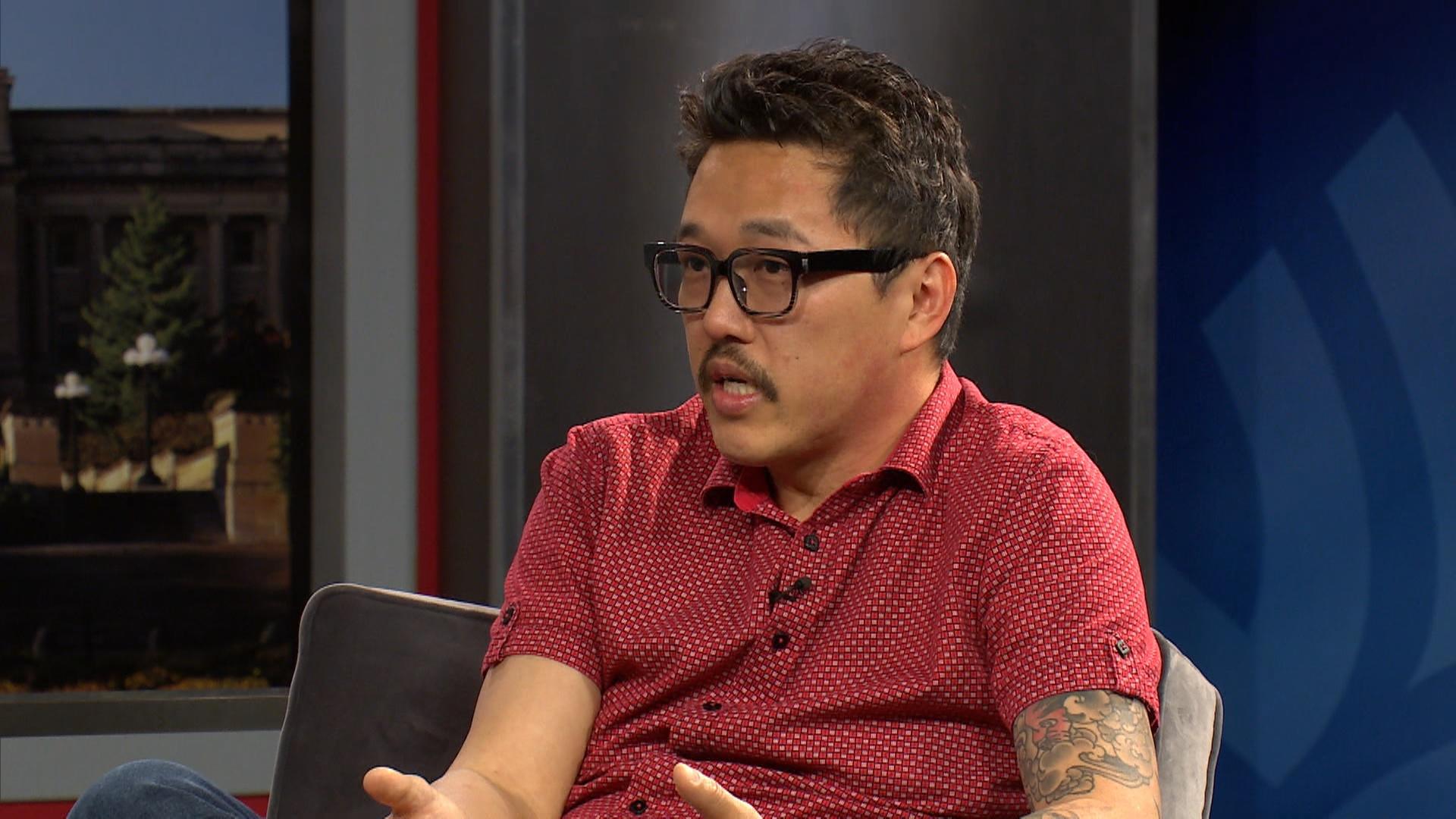


The 2020 deaths of Breonna Taylor and George Floyd at the hands of police caused Dan Wu to think more deeply about racism in America and engage in efforts for racial justice.
But when a gunman killed six women of Asian descent in the Atlanta area in late March, the Chinese-born Lexington restaurateur says he felt an unnamable anxiety. The victims weren’t from some other minority group. They had last names like his and they looked like his mother. Suddenly, Wu says racial violence hit home for him in a way that it never had before.
“I hate almost that it had to take that for me to get to that next level of feeling this is what it feels like to be targeted, to be hunted, to be victimized in this way,” he says. “Asian Americans have suffered from racism and discrimination... from the day we set foot in this country.”
Wu spoke about his experiences as part of a series of Connections conversations about an increase in violence against Asian Americans and Pacific Islanders over the past year.
A ‘Model Minority’
For a time in the mid-1800s, America welcomed Chinese immigrants to work in the California gold rush and on the Transcontinental Railroad. But after the Civil War, as the national economy struggled, public sentiment turned against Chinese-Americans. The men were blamed for taking jobs and depressing wages for white laborers, and Chinese women were seen merely as sex workers.
“The Asian woman in the history of America has always been an object of fetish, an object of desire, and also blamed as a seductress or someone who’s going to ruin the morals of the white man,” says Wu.
A series of federal laws restricted the number of Chinese who could immigrate to America from the late 1800s to the mid-1960s. Then the Immigration and Nationality Act of 1965 opened the door for countless people of Asian descent to come to the United States.
Wu’s own family was among the immigrants who benefitted from the new policy. He was eight years old when he and his parents came to the United States and eventually settled in Lexington, where his father worked at the University of Kentucky and opened a Subway sandwich shop.
In the decades since, Wu says Asians of many nationalities and cultures have come to be seen as a “model minority” in America, known for their intelligence, hard work, quiet reserve, and subservience. He says that allowed many Asian Americans to adopt a kind of conditional whiteness.
“You can get the benefits and the privileges and the trappings of whiteness if you stay down, you stay quiet, stay in your lane,” Wu says.
But in the process, Wu says Asian Americans have relinquished their autonomy and lost control of their cultural narratives. What’s worse, those sacrifices no longer protect them from racial violence, says Wu.
Showing Up for Each Other
There have been at least 3,800 acts of harassment and violence against Asian Americans and Pacific Islanders since last year, according to a report from the group Stop AAPI Hate.
Some people blame former Pres. Donald Trump’s anti-immigrant rhetoric and his labeling of COVID-19 as the “China virus” for the increase in violence against Asian Americans. But Wu contends anti-Asian sentiment predates the pandemic and Trump.
“He has finally given permission for people to say out loud the things that they were thinking in their heads,” says Wu. “He’s amplified that kind of hatred and racism, and he’s normalized it, but he didn’t create any of these problems.”
Because people of Asian descent have such different backgrounds, Wu says they have a wide variety of immigrant stories. As a documented, educated, straight male, he says his immigrant experiences are different than what other Asians have endured after coming to America. His self-described “crazy crooked” life also includes an art studio degree from UK, a stint on the reality TV show MasterChef, and becoming a husband and father.
Despite being an entrepreneur and restaurant owner, Wu he says he lives with what he calls “micro-aggressions.” For example, he says people compliment his English even though he’s lived in the United States most of his life. As a successful person of color, he says he got used to downplaying those slights.
“In my mind was always we haven’t had it as bad as Black folks,” says Wu. “I feel stupid complaining that we’re being oppressed when other people are being killed on the street for no reason.”
But the rise in anti-Asian incidents has caused him to rethink the broader scale of racial violence in America. He penned an opinion piece for the Lexington Herald Leader describing his thoughts about how Americans love Asian culture and food, but don’t value Asian lives. He says he realized that white supremacy creates a scarcity of justice and economic opportunity for minority communities, which results in these marginalized groups competing against each other.
“It sometimes feels like if you give enough attention or give enough justice to Black folks, there’s not enough for me so I need to hoard mine,” he says. “Then suddenly we’re at odds when in fact we’re victims of the same system.”
Wu says systemic racism works exactly as intended when one marginalized group breathes a sigh of relief to have violence directed at a different marginalized group. Instead, Wu says people in all of those groups, whether Asian Americans, Black Lives Matter, or others, should work to unite against what he calls the “Oppression Olympics.” He also wants to shatter the myth of any group being a “model minority” since he says that only serves to subjugate those people and isolate them other individuals who experience their own forms of discrimination.
“I want people to wake up and realize that these are interconnected things and the only way we defeat this interconnected system is to interconnect ourselves,” says Wu. “Interconnect all these movements and all these groups and show up for each other.”